 Live Webinar

AI-driven Design, Sensors and Optics – Scientific Instrumеntatiοn

(Starting: Winter Semester)
- Starting
- Winter Semester
- Mode of Admission:
- local admission restriction (local NC)
- Application:
- Directly to the university.
More Info - Study Mode:
- On campus
University Video
Welcome To Jena – Welcome To Paradise!
Five Reasons to choose this Master's Program





Open Campus 2026
We look forward to your visit in Jena on 25 April 2026

Course Description
Discover the future of scientific innovation with the University of Applied Sciences Jena.
This program not only equips students for cutting-edge R&D roles but also empowers them to lead and innovate. With a special focus on AI-driven Design, Sensors, and Optics, the curriculum bridges traditional engineering expertise with the technologies shaping tomorrow. Building on Jena’s rich legacy of over a century in pioneering scientific instrument development, students become part of a long-standing tradition of excellence — where tradition meets modernity. The result is a unique academic environment that places them at the forefront of applied physics, optics, and precision engineering. Enroll today and be part of shaping the future of science!

The Master’s in Scientific Instrumentation at University of Applied Sciences Jena is tailored for ambitious students with a foundational degree in sciences, IT or engineering. Ideal candidates are those who possess a keen interest in advancing their knowledge in scientific instruments engineering. Whether they are recent graduates eager to build on their academic foundation, or professionals seeking to deepen their expertise and pivot into specialized roles, this program offers the comprehensive training needed.

Online Consultation | 10 February 2026, 1.30–2.30 p.m.

Special Program Features
Be Part Of A University With A Vision
The University of Applied Sciences Jena stands is a vibrant academic community of approximately 4,400 students spanning technology, business, social affairs, and health. Emphasizing interdisciplinary collaboration in all facets, from teaching to research, the university is nestled in the picturesque city of Jena, offering a rich student life. → More Info
Three Specialization Paths to Shape Your Expertise
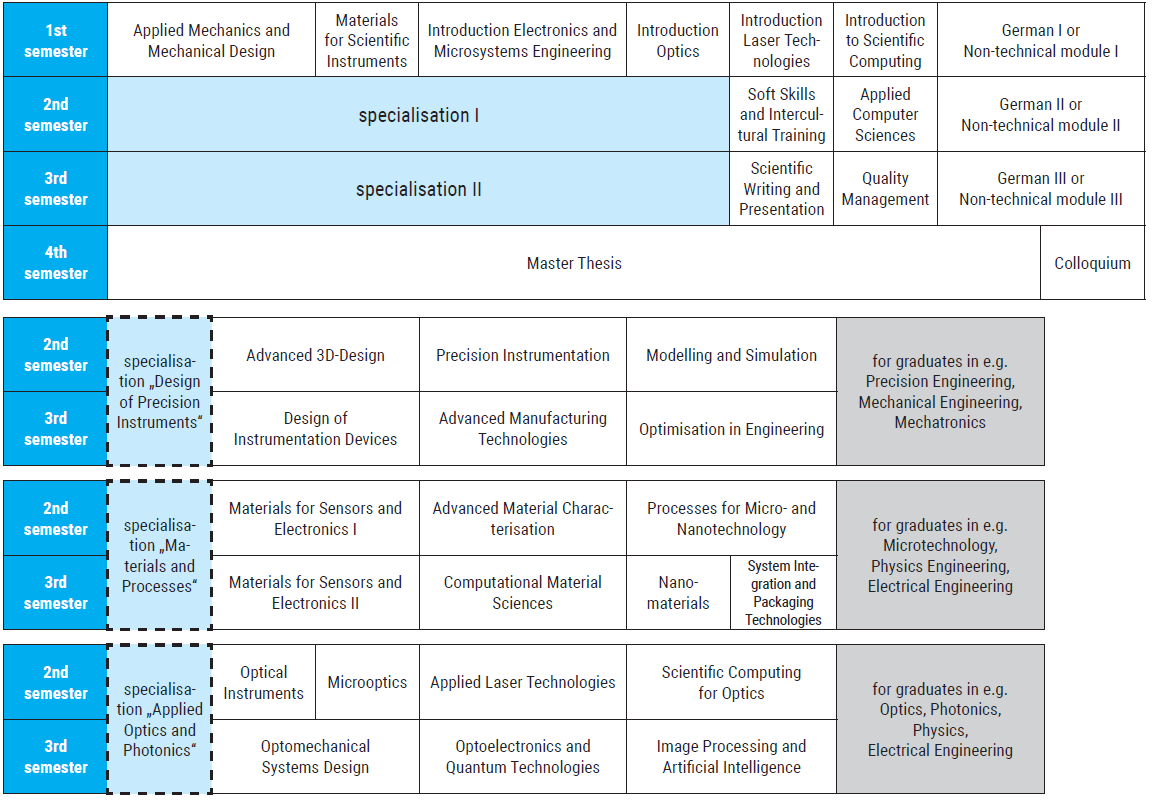
Students can choose from three specialization options: Design of Precision Instruments focusing on mechanical design and product development, Materials and Processes emphasizing functional materials and micro- & nanotechnologies, and Applied Optics and Photonics centered on optical engineering and image data processing.
State-of-the-Art Laboratories
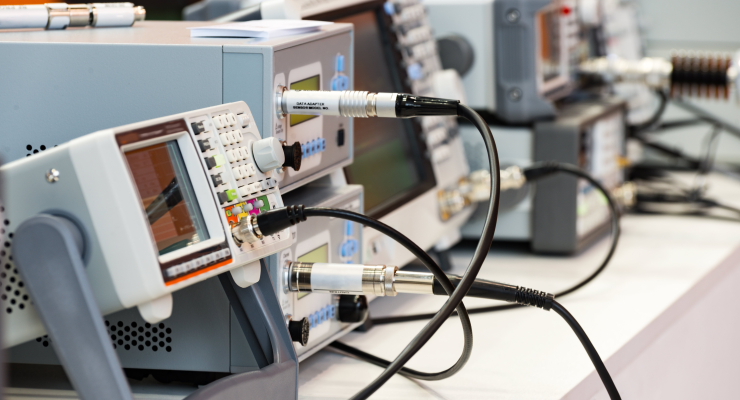
Students have access to cutting-edge laboratories and equipment, ensuring they are equipped with practical skills and hands-on experience, vital for their future careers in scientific instrumentation.
Accreditations
ACQUIN
ACQUIN
The Accreditation, Certification and Quality Assurance Institute is a school accreditation system whose main objective is to provide guidance and information for students, employers, and higher education institutions. It aims to contribute to more transparency in the market of study programs.
Requirements
Qualification Requirements
The application requirements for the study program in "AI-driven Design, Sensors and Optics – Scientific Instrumеntatiοn" are:
A previous Bachelor‘s degree (or equivalent) in a technical or scientific field whose curriculum covers the special educational prerequisites for the Master‘s program in Scientific Instrumentation, such as:
- Information and Communication Engineering, Information Technology, Computer Science and related fields (NEW)
- Mechanical Engineering
- Electronic Engineering and related fields
- Mechatronic Engineering
- Materials Engineering
- Physic
- Optical Engineering
- (Bio)medical Engineering
- Aerospace Enginееring
According to the regulations, admission can be gained by getting 55 out of 115 points using the following calculation:
- Convert your grade to a German grade using the Bavarian Formula.
- Calculate points: points = (4 - German grade) x 15.
- Up to 50 points can be added if your previous course matches well.
- Up to 15 points can be added for relevant scientific results or publications.
It is important to note that the university uses percentage rather than GPA. It is therefore important to include a conversion paper in your application documents, if availablе.
Language Requirements
The following certificates are recognized as proof of your language proficiency.
 English
Application & Admission
Application Deadlines

Locked
Login or Sign-up (for free) to:
- → request information packages
- → see your personal application deadline & tuition fee
(Starting: October)
 Germany
 Another EU Country
 Rest of the world
Application Procedure & Selection
For international applicants: Please transfer the processing fee of 75 € to the university’s bank account.
Application Documents
Signed printout of the filled online application form for the Master's prοgram.
Use the Bavarian formula for grade conversiοn.
Only for applicants from P.R. China, India or Viеtnam.
Copy of your bank transfer form showing the application fee transfer (75 eurοs).
- Only for applicants from India: A document allowing the conversion from CGPA to percеntagе.
Testimonials
In the Master of Scientific Instrumentation, most of the classes have practical laboratories where you can combine all the theoretical knowledge with practice, and you have to write one report on that practice. So the program gives you the possibility to apply the theoretical knowledge in practical ways.

Location
Further Information
Your Personal Contact
Prof. Dr.-Ing. Ronny Gerbach
Contact for applicants
Contact Details:
+49 3641 205 362
[email protected]
Information Package
Get further information with one click!
Learn More About the M.Sc. Scientific Instrumentation here!
