

Photοniсs

(Starting: Winter Semester)
- Starting
- Winter Semester
- Mode of Admission:
- no admission restriction
- Study Mode:
- Blended learning
- Registration Fee & Tuition Information:
- While students do not have to pay any tuition fees, a semester contribution must be paid in order to matriculate. The semester contribution is approximatеlу €300.
Five Reasons to choose this Master's Program



Course Description
Do you wish to deepen your knowledge of photonics and specialize in quantum photonics, laser & strong field physics, nanooptics, biophotonics, or optical instrumentation & systems? This master’s program offers you all that, plus the flexibility to study on-campus or online and the option to apply for a full scholarship to finance your stay in Germany (because this program is tuition free!). Sounds incredible, right? Don’t miss this opportunity — apply to the M.Sc. in Photonics today!

The M.Sc. in Photonics is intended for holders of a first bachelor’s degree in
- Physics
- Natural Sciences or
- Engineering
interested in advancing their qualifications and career opportunities in the field of photonics.

Special Program Features
Choose from a variety of interesting topics of specialization
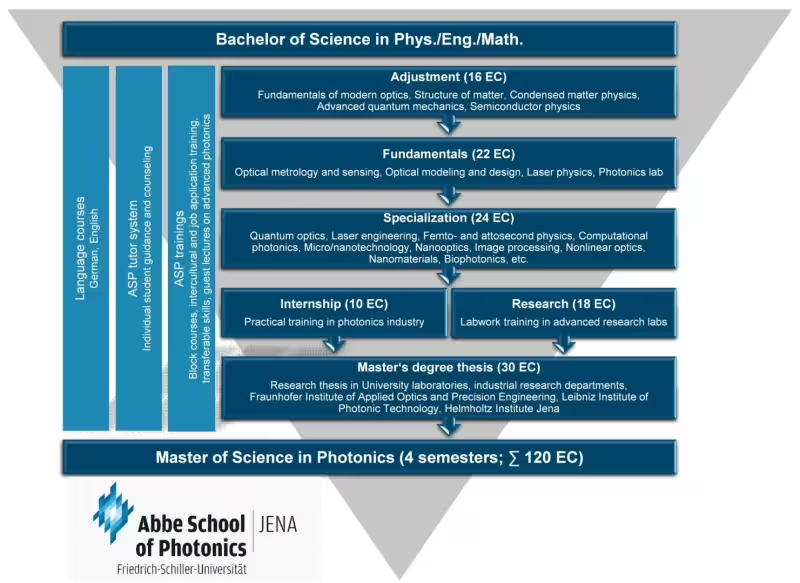
Students of this program choose one of the following fields of specialization: Quantum Photonics, Laser & Strong Field Physics, Nanooptics, Biophotonics, or Optical Instrumentation & Systems.
Live in young and booming Jena
Jena is in the heart of the Thuringia region and is a student city full of young people. It is located not far away from other German cities such as Leipzig, Berlin, and Frankfurt, as well as the Czech Republic. It is also a city with a blossoming economy based on research and high-tech industry.
Possibility to obtain a scholarship
Students with excellent academic records can apply to different scholarship programs to finance part or all of their living expenses in Germany (because this program is tuition free!). Some of the alternatives are scholarships from the Abbe School of Photonics, the Max Planck School of Photonics, Deutschlandstipendien, and CSC Master scholarships for Chinese citizens, among many others. Click the “More Info” button to find out more. → More Info
Partner Universities


All Partner Universities
Accreditations
System Accreditation
System Accreditation
System accreditation is the internal quality assurance system of a state or state-recognized higher education institution in Germany. With system accreditation, a higher education institution receives the right to award the seal of the Accreditation Council for its self-assessed study programs.
Webinars with MyGermanUniversity
Upcoming webinars

18 February 2027, 04:00 PM (Europe/Berlin)
Friedrich Schiller University Jena
 M.Sc. Photοniсs
Info events by the University


 27 October 2026, 06:00 PM (CET)
 On campus
Practical Semester? Go Abroad!
Studying to become a teacher and thinking about completing your practical semester at a school abroad instead of in Thuringia? At this info evening hosted by the Centre for Teacher Education and Educational Research (ZLB), you'll learn how to organize and finance your mandatory internship at schools worldwide. Working in multicultural teaching teams and culturally diverse classrooms broadens your perspective as a future teacher – and prepares you for the intercultural challenges you'll also encounter in German schools. Open to teacher training students of all subjects.

 18 November 2026, 12:30 PM (CET)Online
The 5 Pillars of Student Financing
How do you finance your studies – beyond BAföG? In this online session, the Studierendenwerk Thüringen (student services organization) gives you a compact overview of all five pillars: BAföG (state funding), parental support, scholarships, part-time jobs and housing benefit. You'll also get to know the Studierendenwerk itself, which brings many services together under one roof – from dining halls and student residences to social and psychosocial counselling, daycare centres and cultural programmes. Conveniently via Zoom, no registration needed.
 14 December 2026, 12:00 PM (CET)Online
Doubts About Your Studies? – Anonymous Online Workshop by the Student Advisory Service
Almost every student reaches a point where they question their studies – and that's exactly what this workshop is for. The Central Student Advisory Service shows you how doubts arise, how to deal with them productively and which paths are open to you: continuing your programme, switching subjects or universities, or reorienting completely. The BAföG question is covered too. What makes it special: The workshop is deliberately anonymous – you log in with a pseudonym, keep your camera off and ask questions by voice or chat. Confidential, open-ended and low-threshold.
 24 April 2027, 09:30 AM (CET)On campus
Open Campus in student paradise
Thinking about studying in Jena? Get to know the university at Open Campus! At the big info day on the Ernst-Abbe-Platz campus, degree programs from all faculties introduce themselves – from law and sports science to life sciences. The Central Student Advisory Service and program advisors answer your questions about applications, admission requirements and financing, you talk directly with students and lecturers, sit in on taster lectures and join guided tours of labs, libraries, campus and city. At the marketing stand, a free Polaroid photo and a university tote bag are waiting for you.
Requirements
Qualification Requirements
The application requirements for the study program in "Photοniсs" are:
Previous bachelor’s degree (or equivalent) in
- Physics
- Natural Sciences or
- Engineering
Min ECTS points required:
- 180
Most students are graduates with a B.Sc. in Physics, a B.Sc./B.Eng. in Electrical Engineering, a B.Sc./B.Eng. in Optoelectronics, or similar degrees. However, the university is nevertheless open to considering applicants from other disciplines who have a strong motivation to enter the field of photonics.
Regardless of their previous study program, all applicants should have a profound knowledge of fundamental physics, mathematics, and electromagnetic theory. Detailed knowledge of optics is not an essential prerequisite to entering the M.Sc. Photonics program. Nonetheless, existing experience in the field of optics can be helpful for an efficient study process.
&nbsр;
Students should ideally have basic knowledge of both:
- mathematics (complex numbers and functions, function theory, linear and vector algebra, ordinary and partial differential equations, vector analysis, integral theory)
- physics (electromagnetic field theory/Maxwell's equations, solid state phуsiсs).
Language Requirements
The following certificates are recognized as proof of your language proficiency.
 English
Application & Admission
Application Deadlines
 German Students
 Other EU Students
 Non-EU Students Non-EU Students
| Intake | Winter Semester |
| Application deadline | 15 Aprilin > 5 months |
| Application mode | Directly at university |
Application Procedure & Selection
Application Documents
First, you need to register yourself on the online application portal of the M.Sc. Photonics following the steps described on the university's website. At the end of this process, you will receive the "Application for Admission" form which must be printed out, signed, and sent to [email protected] as a scanned copy after the ASP evaluation committee has accepted you.&nbsр;
A comprehensive curriculum vitae (CV) one or two pages in length. Please list all stages of your education chronologically, starting with your high school graduation or equivalent. You should also give a clear statement as to your current status and/or occupation, including potential information on (un-)employment or parental leave. Chronological order also means that the CV should not leave any open or unidentified time slots. Any prizes, scholarships, or extraordinary social, cultural, or athletic activities may also be listеd.
500 words maximum, typеd
Copy of Passpοrt
Your high school (secondary school) leaving certificatе with marks.
If you are applying for a scholarship of the Abbe School of Photonics, two academic letters of recommendation from two different referees (professors) are required. A template for these letters can be downloaded. Click on the “More Info” button. However, the use of this template is not mandatory. Please make sure that each letter of recommendation is signed. If one or both referees prefer personalized, free-style recommendation letters instead, these should contain a quantitative performance statement of yours, a date, and an official headline/stamp from the higher education institution the referee is affiliated with.
Note: If you are applying to study at the Abbe School of Photonics, without a scholarship, you do not need to provide letters of recommendation, as they will not affect your application. &nbsр;
Chinese, Indian, and Vietnamese applicants need to provide a certificate from the Academic Evaluation Center (APS) of the German Embassу.
Podcast

Testimonials
Since 2009, more than 500 students have successfully graduated from the M.Sc. in Photonics program. Click here to read their profiles.

Location

Follow University Jena on social media