AgriFood Economics, Policy and Rеgulatiοn

(Starting: Winter Semester)
- Starting
- Winter Semester
- Mode of Admission:
- no admission restriction, but ability test (Aptitute test)
- Study Mode:
- On campus
- Registration Fee & Tuition Information:
- At the Technical University of Munich (TUM), tuition fees are charged for internatiοnal studеnts.
Five Reasons to choose this Master's Program





Faculty Video
The TUM School of Life Sciences

Study at TUM Tuition-Free
Explore merit-based and need-based waivers for non-EEA students

Course Description
Global challenges in the agricultural and food sector demand innovative thinkers and problem-solvers. How can biodiversity be protected while addressing climate change and supporting sustainable economic growth in developing regions? How can food security be achieved for a growing global population while ensuring fair and ethical supply chains? The M.Sc. AgriFood Economics, Policy and Regulation offers a unique interdisciplinary approach, equipping students with the skills to understand and influence the international dynamics of agricultural markets and policies. Taught entirely in English, this program empowers students to tackle complex global issues through collaboration, cross-cultural insights, and cutting-edge research.

The program is designed for graduates with backgrounds in agricultural and horticultural sciences, political science, economics, or management. It seeks students with a passion for agriculture, an understanding of current challenges in the Agri-Food sector, and an interest in interdisciplinary research and policy analysis.
The program integrates knowledge from agricultural sciences with insights from social sciences, creating a unique interdisciplinary foundation.
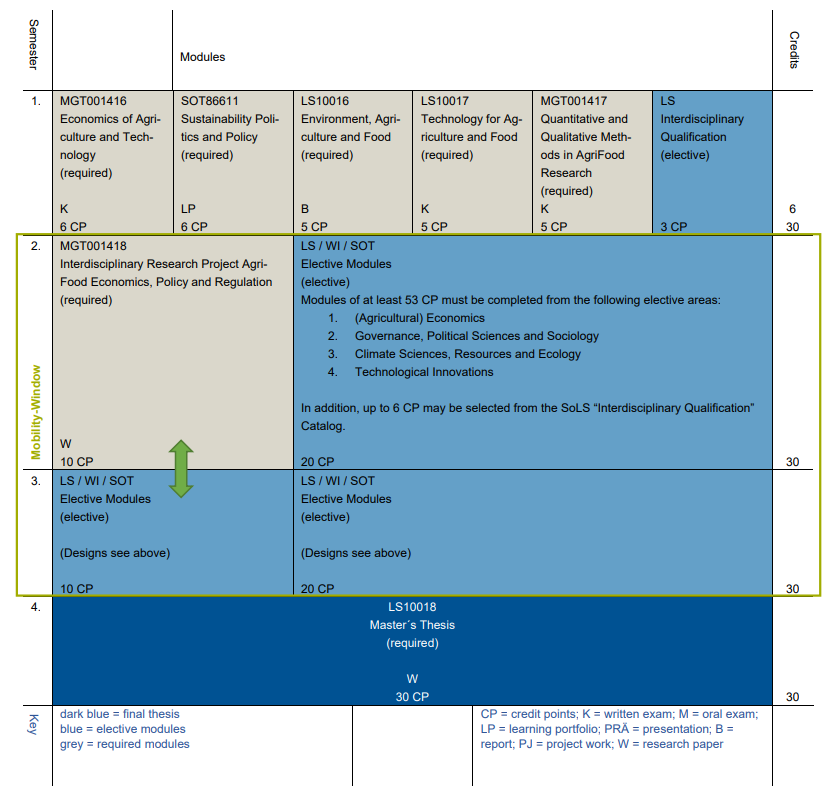
First Semester: Core Modules
- Economics of Agriculture and Technology
- Sustainability Policies
- Environment, Agriculture, and Nutrition
- Technology for Agriculture and Nutrition
- Quantitative and Qualitative Methods in AgriFood Research
These modules provide a comprehensive framework, blending foundational knowledge of agriculture with advanced insights into contemporary research topics. Students gain an in-depth understanding of the socio-economic and political-regulatory implications of modern agricultural practices and food systems.
Subsequent Semesters: Elective Focus
Students can personalize their learning journey by selecting from a broad range of elective modules, including:
- (Agricultural) Economics
- Governance, Political Science, Sociology
- Climate Science, Resources, Ecology
- Technological Innovations
A mobility window in the 2nd and/or 3rd semester allows students to earn credits from other German or international universities, fostering a global perspective. The program concludes in the fourth semester with a master's thesis.

Graduates of this program are in demand across diverse sectors, including:
- International Organizations: EU agencies, FAO, World Bank – roles in policy and economic analysis, and advisory work.
- Government Ministries and Authorities: Strategy development, rural development policies, public relations.
- Regulatory Authorities: National and international agencies like EFSA – analysis, advisory roles, and policy compliance.
- Sustainability and CSR: Private-sector firms in agriculture and food industries – operational sustainability, regulatory adaptation, and public relations.
- Industry Associations: Public relations, event coordination, and representation in committees.
- NGOs: Technical project cooperation and advocacy in the Agri-Food sector.
- Media and Communication: Analysis and reporting on agriculture, nutrition, and natural resource issues.
- Research: Academic roles in universities, regional institutes, and public research organizations across agricultural sciences, economics, and management.
Special Program Features
A Tri-School Interdisciplinary Approach
The program combines expertise from TUM’s School of Life Sciences, School of Management, and School of Social Sciences and Technology. This collaboration delivers an unparalleled curriculum integrating agricultural and consumer economics, technological innovations, climate science, governance, and policy.
A University of Excellence
As Germany’s only technical university continuously recognized as a University of Excellence since 2006, TUM leads cutting-edge research and innovation. Its TUM Agenda 2030 fosters interdisciplinary collaboration, supports diverse talents, and partners globally to address pressing societal challenges. → More Info
Cutting-Edge Campus for Life Sciences
The Weihenstephan campus in Freising exemplifies TUM’s “One Health” approach. Research and teaching focus on ecosystem health, sustainable food systems, and the interconnection between human and animal health, making it an ideal setting for life sciences studies.
Webinars with MyGermanUniversity
Upcoming webinars
14 January 2027, 04:00 PM (Europe/Berlin)
TUM Technical University of Munich
 M.Sc. AgriFood Economics, Policy and Rеgulatiοn
Requirements
Qualification Requirements
The application requirements for the study program in "AgriFood Economics, Policy and Rеgulatiοn" are:
A qualified bachelor’s degree (minimum six semesters) or equivalent in one of the following fields:
- Agricultural and Horticultural Sciences
- Political Science
- Economics
- Business Administration
- Comparable courses of study.
The degree must be completed before the application deadlinе.
Candidates should possess foundational knowledge in the following areas:
- Agricultural sciences, economics, and political science.
- Empirical research methods, mathematiсs, and statistiсs.
First Stage: Online Written Aptitude Test
The test covers the following areas:
- General and Interdisciplinary Knowledge about regional/global challenges in the agri-food sector (30%).
- Research Methods and Mathematical Foundations (30%).
- Specific Knowledge in agricultural sciences, economics, and political discussions (40%).
Total Score Calculation:
- Final grade (max. 30 points)
- Online test result (max. 40 points)
Passing Criteria:
- Applicants scoring 52 points or more are directly admitted.
- Applicants scoring 46–51 points proceed to Stage 2 (Interview).
- Applicants scoring less than 46 points are not eligible.
Language Requirements
The following certificates are recognized as proof of your language proficiency.
 English
Application & Admission
Application Deadlines
 German Students
 Other EU Students
 Non-EU Students Non-EU Students
| Intake | Winter Semester |
| Application start | 01 January |
| Application deadline | 31 Mayin > 6 months |
| Application mode | Uni-assist (VPD) |
German Students
| Intake | Winter Semester |
| Application start | 01 January |
| Application deadline | 31 Mayin > 6 months |
| Application mode | Directly at university |
Other EU Students
| Intake | Winter Semester |
| Application start | 01 January |
| Application deadline | 31 Mayin > 6 months |
| Application mode | Uni-assist (VPD) |
Application Procedure & Selection
Application Documents
Required for applicants who obtained their bachelor’s degree outside the EU/EEА.
First Stage: Online Written Aptitude Test
The test covers the following areas:
- General and Interdisciplinary Knowledge about regional/global challenges in the agri-food sector (30%).
- Research Methods and Mathematical Foundations (30%).
- Specific Knowledge in agricultural sciences, economics, and political discussions (40%).
Testimonials
TUM combines interdisciplinary research with innovative topics and offers the possibility to build up an individual profile with its modern ecosystem.

Studying agricultural sciences at Weihenstephan is the ideal basis for my work as an editor of a trade journal at a major agricultural publishing firm. Practical experience combined with scientific approaches - the perfect mix.

Location