










- What is the German U15
- German U15 Universities
- German U15 English Programs
- Cost of Attending a German U15 University
- Are the Non-U15 Universities a Good Alternative?
 Germany's largest study program database
 Browse study programs
24,048 courses available


What to study?
Where to study?
The German U15 university alliance is one of many university corporations in Germany (like TU9, UAS7, Berlin University Alliance, UA Ruhr). The fifteen universities which make up the U15 are top-ranked universities in Germany and, therefore, are often sought out by international students. However, students should be sure to consider partner universities of such associations, but also note that these alliances should not play a significant “make it or break it” role in choosing a study program.
If you are interested in studying in Germany, you should familiarize yourself with the many different university alliances. The 535 Universities in Germany have many different alliances, associations, and partnerships. The members of such coalitions depend on the topic focus of universities (technical focus, arts, business, arts, etc). These alliances are meant to foster cooperation among universities and, therefore, many students seek out institutions that are part of a multi-university alliance.
What is the German U15

U15 is an association of fifteen research-intensive universities and medical universities in Germany. As mentioned above, many German universities form alliances with nearby or thematically related universities in order to optimise their competitiveness with other university corporations in Germany. The U15 has also been a member of the Global Network of Research Universities since 2014. This network includes university alliances from all over the world, including the UK, USA, Europe and Asia.
The U15 universities, like many other alliances, have research centres and work with industry partners to create opportunities for students such as internships and work placements. In addition, all the universities are public. In Germany, public universities generally do not charge tuition fees, even for non-EU students. Therefore, anyone can apply to a U15 partner university. The following article gives a brief overview of the partner universities and the English-taught programmes for international students.
German U15 Universities
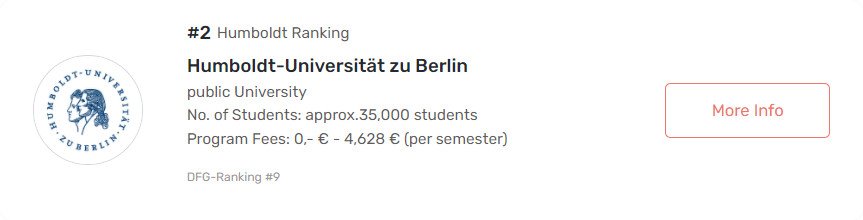
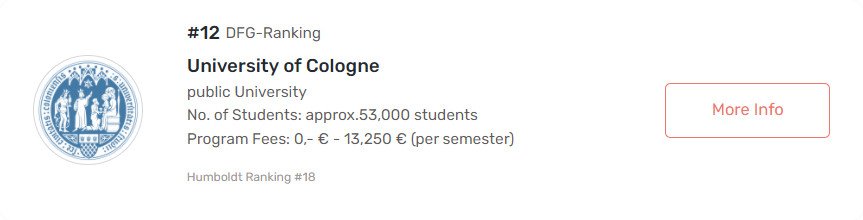
U15 is made up of fifteen universities from all over Germany. Below is a brief profile of each partner university. Click on each profile to see statistics about each university, such as entry requirements, rankings and English taught programmes:













German U15 English Programs
The U15 partner universities are not exclusive to German students. Not only do they welcome international students, but they also offer a variety of courses in English. To make the search process easier for students, we list the more than 400 English-taught master’s courses from U15 universities on our site. Alternatively, you can click on the universities below to see the English-language courses they offer:
LMU - Ludwig-Maximilians-Universität München
Freie Universität Berlin
Humboldt-Universität zu Berlin
Heidelberg University
University of Bonn
University of Göttingen
University of Freiburg
University of Tübingen
University of Cologne
University of Münster
Goethe University Frankfurt
Universität Hamburg
Johannes Gutenberg University Mainz
Julius-Maximilians-Universität Würzburg
Leipzig University
Keep in mind that while there are many English-taught programs available, international students may also apply for courses taught in German. Whether you are applying for a study program taught in English or German, it is important to observe the language requirements of the program carefully to ensure you meet the requirements.
Cost of Attending a German U15 University

Public universities in Germany are free of tuition fees, with very few exceptions, which are detailed in the table below. The U15 universities are exclusively public. However, there are some exceptions to free tuition. Specialised executive master's programmes (e.g. LLM, MBA, MPA, etc.) may sometimes charge tuition fees. Of course, this depends on the university and the programme, so check each programme page carefully. To give you a general idea, below is an overview of tuition fees in Germany:
German Higher Education Costs
| Tuition Fee | vs. | Semester Contribution |
| pays for the study program | pays for administrative costs, social services provided by the university, local public transportation ticket for unlimited use throughout the semester | |
| averages 5,000 - 7,000 € per semester | averages 200 - 300 € per semester | |
| charged by private universities and specialized professional degrees (e.g. LLM, MBA, etc.)* | Charged by all universities |
*In the southwest of Germany lies the state of Baden-Württemberg. Baden-Württemberg has a mandatory tuition fee of 1,500 € per semester to all non-EU students.
Keep in mind that while some programs are not tuition-free, you shouldn’t overlook them on your master’s program search. Should you be interested in a program that charges tuition, keep your many funding options in mind. There are many scholarships available for international students. Also, be sure to refer to DAAD Scholarships for international students in Germany.
Are the Non-U15 Universities a Good Alternative?

Taken as a whole, the U15 alliance represents the 15 of the biggest and most research-intensive non-technical universities in Germany - with a total of more than 500,000 students. Nevertheless, it is only ONE section of the very rich German university landscape. In total there are more than 100 universities in Germany (many internationally top-ranked) with a total of 1.75 million students. While the German U15 universities partners are sought out among international students, know that there are many other nationally top-ranked universities to choose from. There are even other university alliances such as the TU9 or the UA Ruhr, for example.
It is common that international students, not being experts in the German university landscape, look for a marker of a “high-quality university.” The truth is that universities don’t necessarily need to be part of an “elite alliance” to be an excellent institution. In fact, what matters most are the individual study programs. While the U15 university members are top-ranked institutions, students should not believe that they are the only place where one can study. For this reason, we recommend you should also have a look at our article about universities in Germany to get a better understanding of the German higher education system.