Browse Study Programs
22 courses available

Signal Processing in Germany
Germany is a top destination for international students pursuing Signal Processing, offering world-class education at the intersection of mathematics, electrical engineering, and computer science in a country renowned for technological innovation in telecommunications, automotive radar, and medical imaging. Studying Signal Processing in Germany means joining leading institutions such as TU Munich’s Signal Processing group, RWTH Aachen’s Institute of Communication Systems, or the Fraunhofer Institute for Integrated Circuits IIS—home of the MP3 invention—where breakthroughs have shaped global standards in audio, wireless, and imaging technologies. Programs provide comprehensive training in digital signal theory, statistical signal analysis, and advanced machine learning methods, combined with practical applications in audio engineering, image recognition, biomedical signals, and wireless communications.
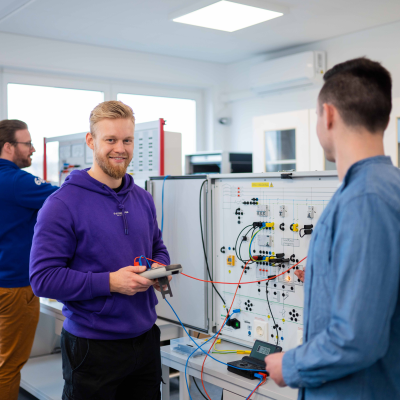
Show more...Germany is a top destination for international students pursuing Signal Processing, offering world-class education at the intersection of mathematics, electrical engineering, and computer science in a country renowned for technological innovation in telecommunications, automotive radar, and medical imaging. Studying Signal Processing in Germany means joining leading institutions such as TU Munich’s Signal Processing group, RWTH Aachen’s Institute of Communication Systems, or the Fraunhofer Institute for Integrated Circuits IIS—home of the MP3 invention—where breakthroughs have shaped global standards in audio, wireless, and imaging technologies. Programs provide comprehensive training in digital signal theory, statistical signal analysis, and advanced machine learning methods, combined with practical applications in audio engineering, image recognition, biomedical signals, and wireless communications. Students gain hands-on experience in cutting-edge laboratories equipped with software-defined radios, GPU clusters for real-time processing, and industry-standard DSP hardware, while internships at companies like Rohde & Schwarz, Continental, Siemens Healthineers, and innovative startups connect classroom learning with real-world projects.
The curriculum emphasizes both rigorous theoretical foundations—such as Fourier analysis, spectral estimation, and filter design—and frontier topics like compressed sensing, adaptive filtering, and deep learning for signal processing, preparing specialists who can address challenges in 5G and 6G networks, IoT devices, autonomous vehicles, and next-generation medical diagnostics. With growing global demand, graduates typically start with salaries of €50,000–€60,000 and pursue careers as DSP engineers, algorithm developers, system architects, and research scientists in telecommunications, automotive, aerospace, and healthcare industries. Germany’s unique combination of tuition-free or low-cost education at technical universities, strong mathematical rigor valued worldwide, extensive collaboration with industry, and an 18-month post-study work permit provides international students with an ideal pathway to launch high-tech careers. This fusion of theoretical depth, practical innovation, and exceptional job prospects makes Germany one of the most attractive destinations for students eager to shape the technologies that process and interpret our digital world.
Show lessBrowse Study Programs
22 courses available
 Type in your Subject, e.g., Economics
 QS Ranking


 1 program
 Which degree?
 Choose degree
 German Students
 Other EU Students
 Non-EU Students German Students German Students Other EU Students
 Non-EU Students Non-EU Students
 Specific courses may have different application deadlines. Please always double-check the information individually. StudyFinder
 UniFinder
 back to top

 Sort by:
 People Also Search
 You May Also Like


 Master of Engineering


 Discover More